From frustration to framework: Building on Midnight

After participating in three hackathons this year, I thought I had a good idea of what to expect. Then came the fourth. It began like the others: an idea, a challenge, a blank terminal screen. But this one took an unexpected turn, one I didn't see coming.
I had recently left my software engineering role to explore zero-knowledge protocols, an area in which I didn’t have much experience. It was a risk, but one I felt I had to take. I chose to pursue this path not only because zero-knowledge cryptography is built on one of the most elegant branches of mathematics, but also I believe privacy on the blockchain or on the internet is fundamental and should never be an afterthought.
One day, my mentor casually mentioned the African Blockchain Championship and suggested I look into the Zero-Knowledge track. That small nudge became a turning point.
That’s when I discovered Midnight!
Meet Midnight: Privacy on the blockchain
Midnight is a zero-knowledge proof-based privacy chain developed by Input Output, the parent company of Cardano. As a partner chain of Cardano, it aims to bring rational privacy through zero-knowledge technology to the broader ecosystem. They weren’t just building another blockchain—they were laying the foundation for private, decentralized computation. After diving into the documentation and setting up the tools, everything was finally in place. All that remained… was to begin. Only later did I realize: this wasn’t just the start of another hackathon—it was the beginning of something much bigger.
Building on Midnight
Hacking on Midnight was challenging, as building in a testnet environment requires constant learning and adaptation to major changes. Within just a few weeks, significant network updates rendered the existing examples incompatible with the latest SDK versions. As a result, an example had to be cloned and debugged line by line. The example repository was dense, filled with layers of files and directories, and figuring out where to start was a challenge in itself.
Fortunately, Midnight’s smart contract language, Compact, shares a syntax similar to TypeScript, which eased the learning curve. I pushed forward, determined to build something meaningful and make my mark—but in the end, my attempt fell short. With midterm exams approaching and the hackathon submission deadline close by, I had to make a difficult decision. I decided not to submit a project to the African Blockchain Championship hackathon. Still, a quiet sense of regret lingered. I couldn’t help but wonder: what if I had just pushed a little harder?
The extended deadline
About a week later, I received an email from the ABC team announcing that the hackathon deadline had been extended. I was thrilled, and I promised myself I’d give it everything this time. It wasn’t long before I was back at it. A few weeks had passed since I’d last touched the project, and during that time, both the network and SDKs had been updated. I gathered my gear, updated my environment, and set out with renewed determination to finally build something solid. I wrote my contract and began debugging, but each change introduced a new layer of complexity. Every update required changes across multiple files. It was frustrating, exhausting, but strangely thrilling. I began thinking of ways to simplify the chaos, to make the process less painful, more intuitive. That’s when I started creating small scripts to streamline the workflow.
Earlier that month, I had joined the Midnight Discord to ask questions. One week, I jumped on a Discord community call, and to my surprise, I learned about an ongoing Midnight tooling hackathon that was happening asynchronously. Right then, it clicked: this was the hackathon I was meant to be part of from the start.
From personal tool to shared project
What started as a personal tool suddenly took on a bigger purpose. The hackathon provided me with the opportunity to share my work with others and contribute to shaping the future of smart contract development on Midnight. I took a little detour from my original hackathon submission—promising myself I’d return to it—and began refining the tool, aiming not just to build something functional, but something genuinely useful for newcomers to the ecosystem.
Scaffold Midnight and create Midnight DApp
That’s how Scaffold Midnight was born, a cloneable GitHub starter template. But I didn’t stop there. I realized it would be even more useful as an npm library, something developers could install with all dependencies bundled and start using right away. So, I polished the project and released the first version as create-midnight-app. But I didn’t want to stop at solving just one problem. Every issue I fixed revealed another. Through multiple iterations, I kept refining the library. It’s now at version 2.1.7, and I’m actively working to make it compatible with the latest release of Compact. It’s far from perfect, and that’s what makes it exciting. Every day, I wake up with a new idea, a new feature to add, or a better way to improve the developer experience!
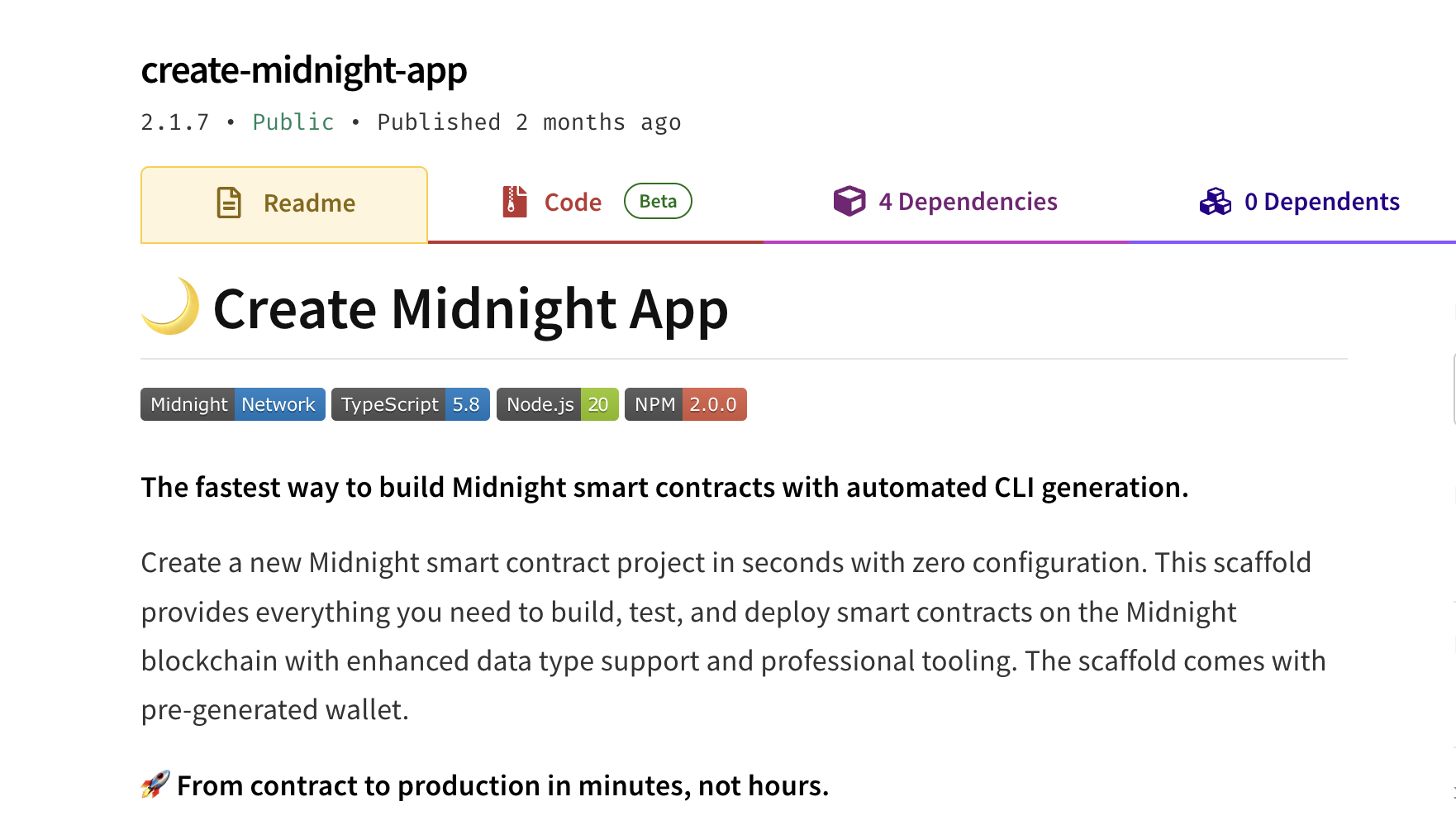
At its core, create-midnight-app is a scaffolding npm library for Midnight that automates the entire setup process. Developers can focus solely on writing their Compact contracts; the tool takes care of the rest. It handles wallet creation, faucet requests, balance checks, API configuration, CLI updates, and even function and file change imports are updated automatically. It reduces initial application setup time from over half an hour to just a few minutes.
I had several euphoric moments while working on this project, but one instance in particular, stands out.
One feature I was eager to build was a way for developers to request testnet tokens without ever leaving their code editor. The simplest idea was to send a request from the terminal directly to the official Midnight faucet. But there was a catch—the site is protected by Cloudflare Turnstile, which blocks automated requests to prevent spam and abuse. As a hacker, I started looking for a workaround. After some Googling and tips from friends, I tested several paid tools that claimed to bypass CAPTCHA protections. I spent an entire afternoon trying them, but none worked reliably. That’s when I remembered the genesis wallet, whose private key is publicly available. So, I implemented a workaround: instead of calling the faucet, I simulated a faucet transaction by transferring tokens directly from the genesis wallet to the user’s wallet. It’s not a long-term solution, and I know it won’t scale—but for now, it works and helps streamline the developer experience.
Submission and recognition
I finally submitted my project, and the judges’ reactions were incredibly encouraging—it gave me a renewed sense of inspiration. With that momentum, I turned my focus back to my original hackathon: the African Blockchain Championship. For this challenge, I built an anonymous, censorship-resistant voting platform. In many African countries—across 34 nations—roughly 30–40% of citizens no longer view voting as a fair or trustworthy process (Afrobarometer, 2023). That’s why anonymous voting isn’t just a feature—it’s a necessity. My project, Privote, aims to address this critical issue by leveraging zero-knowledge technology to protect voter identity and integrity.
As the submission deadline approached, I ran into a major hurdle: integrating the wallet into the frontend. I reached out to one of the Developer Relations Engineers, who kindly shared some example code. Unfortunately, I couldn’t get it working in time. With the clock ticking, I had to improvise. I quickly built a custom Chrome extension that enabled wallet interaction—running through the terminal on the backend—just in time for submission. While the current version still has some privacy limitations, the smart contract compiles successfully, and users can interact with it on the Midnight testnet—offering a real glimpse of what decentralized, anonymous voting could look like in practice.
The Midnight community
Even though there aren’t many resources available yet, the Midnight community more than makes up for it. Almost every question asked on Discord gets a response. It’s a space where people genuinely support each other—even during hackathons, when we’re technically competing and have little incentive to help other teams. In fact, during the hackathon, I often found myself answering questions in the Telegram group. I even hosted a workshop at the ABC hackathon on how to use Create Midnight App, helping others get started quickly and navigate the ecosystem more easily.
I also want to take a moment to thank the Midnight team for the recognition they gave me—it truly meant a lot. Beyond placing first in the CLI track, the support and appreciation I received from the community were genuinely heartwarming. I even had the chance to join a community call—not just as a participant this time, but as a speaker—to share my journey and the lessons I’d learned along the way.
Why now is the time to build on Midnight
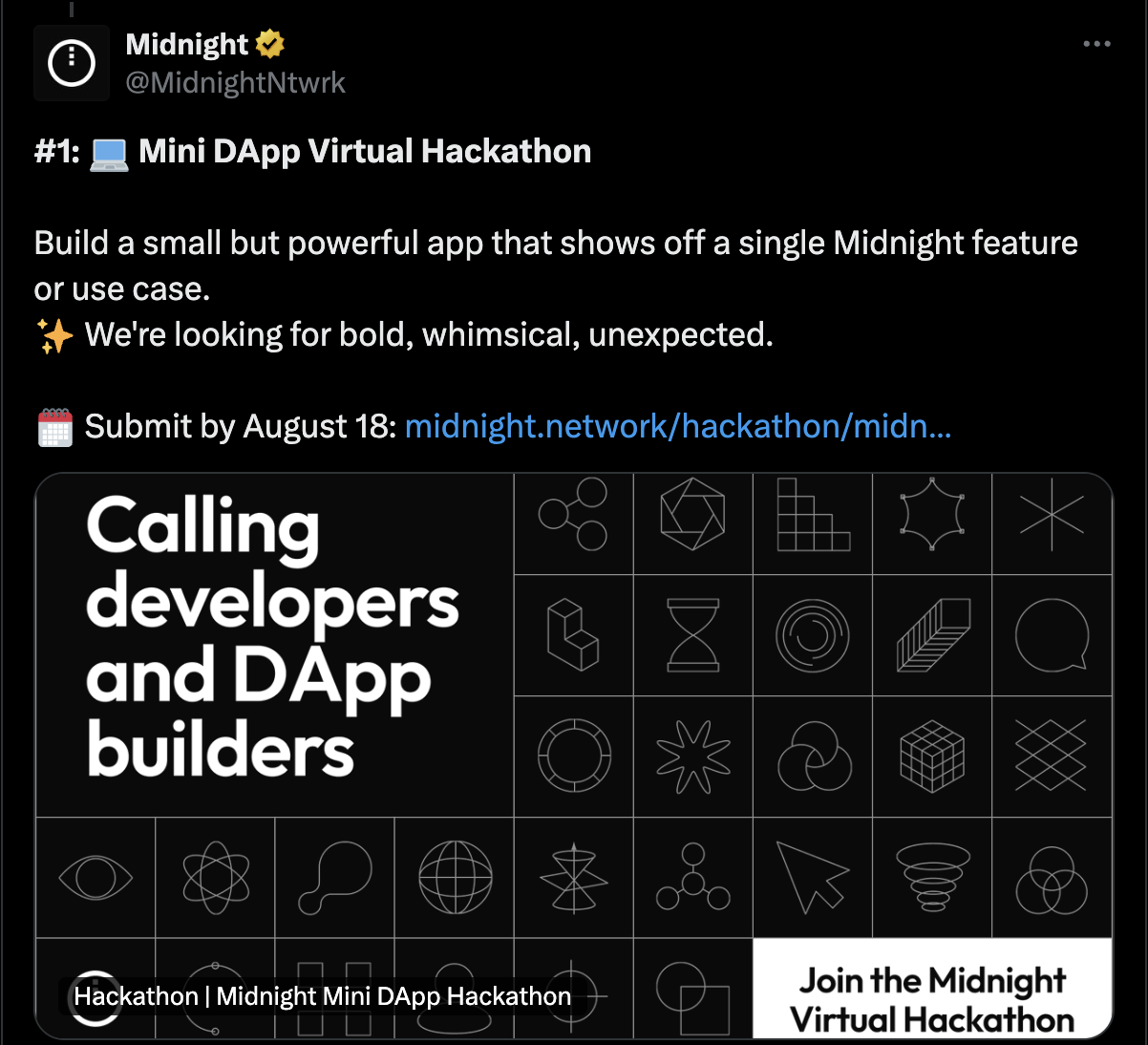
And for you—my readers—this is honestly the best time to get involved in the Midnight ecosystem. There’s almost always a hackathon happening (seriously, it's kind of wild!). Right now, they’re even running a mini DApp hackathon. It’s an excellent opportunity to learn, build, and get your project noticed.
As for me, I’m currently building something new for the hackathon. While I enjoy working on projects, I’ve found even more fulfillment in developing infrastructure tools. I have a long-term goal of building a web-based Midnight playground where anyone can start writing Compact code and begin interacting with the Midnight testnet without needing to install anything. I hope to continue collaborating with the Midnight team and growing my skills—especially in zero-knowledge protocols—as I continue this journey.