For the complete documentation index, see llms.txt
Funding a wallet
Every transaction on Midnight consumes DUST, and DUST comes from NIGHT that you have registered for DUST generation. On the test networks both halves are free: a faucet sends you tNIGHT, and registering it starts tDUST accruing. This guide walks the whole path. You request tNIGHT from the faucet, register it in the Lace wallet, and then do the same programmatically with the wallet SDK when you need funding to be scriptable. For why the two-token model works this way, see Funding and transaction cost.
One term matters throughout. You register NIGHT for DUST generation, the on-chain operation the protocol and SDK also call registration. Lace labels the button Generate tDUST and displays the result as your tNIGHT designation.
Prerequisites
These apply to every procedure in this guide:
- A Lace wallet set up on the target test network, for the faucet and Lace procedures.
- Node.js version 22 or higher, for the wallet SDK procedure. macOS, Linux, and Windows through WSL all work.
- A local proof server on port 6300, for the wallet SDK procedure.
- A Blockfrost Midnight Preprod project token in the
BLOCKFROST_PROJECT_IDenvironment variable, for the wallet SDK procedure. Blockfrost serves the Preprod indexer and node RPC; see Getting a Blockfrost project token. - Vitest alongside the packages listed below, if you want to run the verification tests.
Getting tNIGHT from the faucet
Request free test tokens for the network you develop on. The faucets are rate limited, and test tokens carry no real value. On the local undeployed network there is no faucet and none is needed; use the local network funding menu instead.
Procedure
-
Copy your unshielded wallet address. In Lace, open your Midnight wallet and copy the address that starts with
mn_addr_; the faucet rejects shielded and DUST addresses.Bech32m address formatLace shows wallet addresses in Bech32m format by default. The address encodes its network, for example
mn_addr_preprod1...on Preprod. -
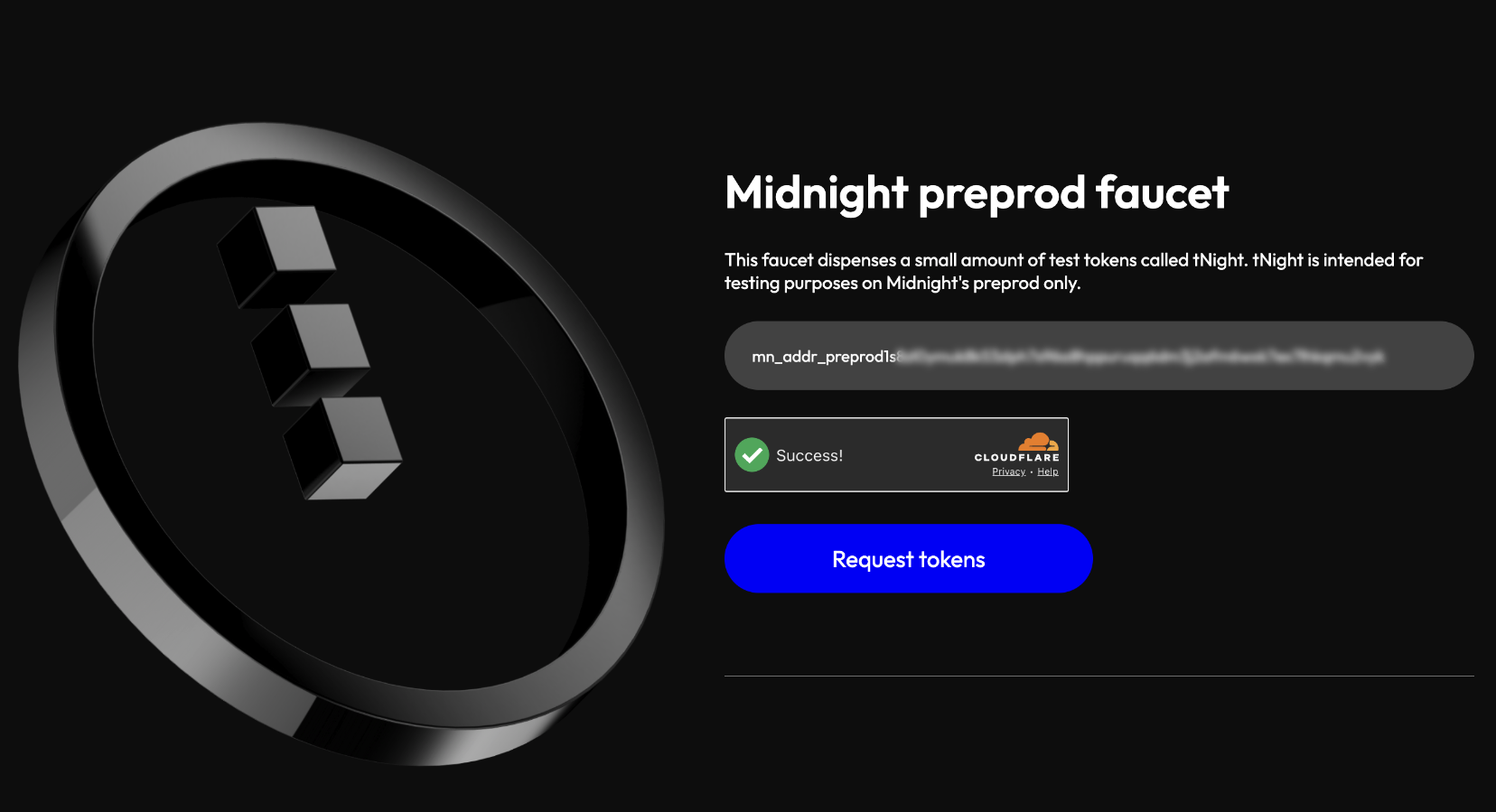
Open the faucet for your network: the Preprod faucet or the Preview faucet. The Environment reference lists both.
-
Paste the address, complete the captcha, and select Request tokens. The faucet confirms the submission:
Transaction submitted. You will shortly receive 5000 tNight in your wallet. This is the transaction ID: 00f15defb8d3...
Verification
The tNIGHT balance appears in your wallet within a couple of minutes: 5,000 tNIGHT per faucet request. In Lace, the unshielded balance updates on the wallet's main view. In code, the balance watcher in Registering NIGHT for DUST generation with the wallet SDK resolves as soon as the funds land.
Registering NIGHT for DUST generation in Lace
Turn your tNIGHT into a source of tDUST. Holding NIGHT alone generates nothing; the registration transaction is what starts generation.
Prerequisites
- tNIGHT in your wallet, from Getting tNIGHT from the faucet.
Procedure
-
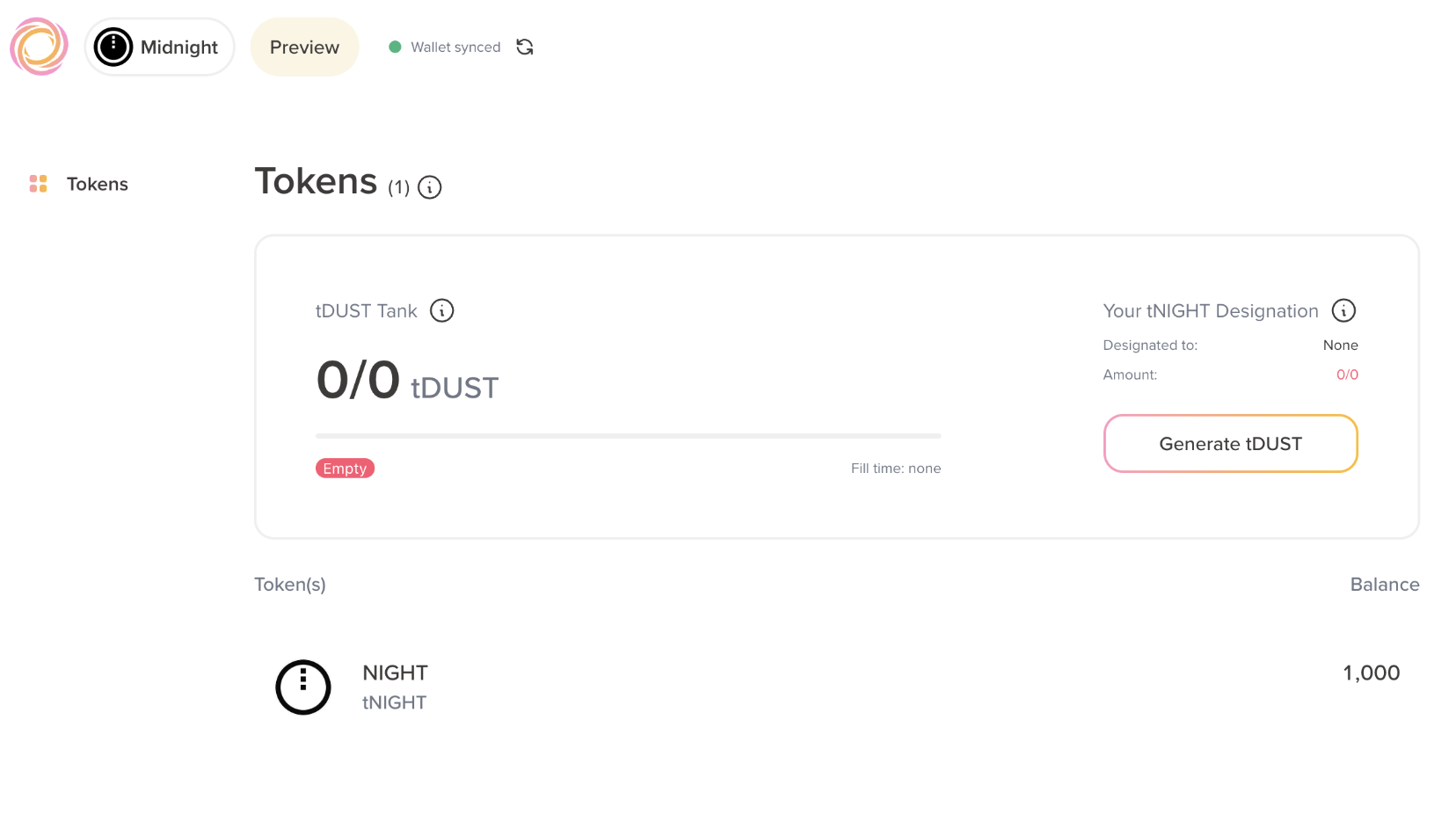
In Lace, open your Midnight wallet and select Generate tDUST.
-
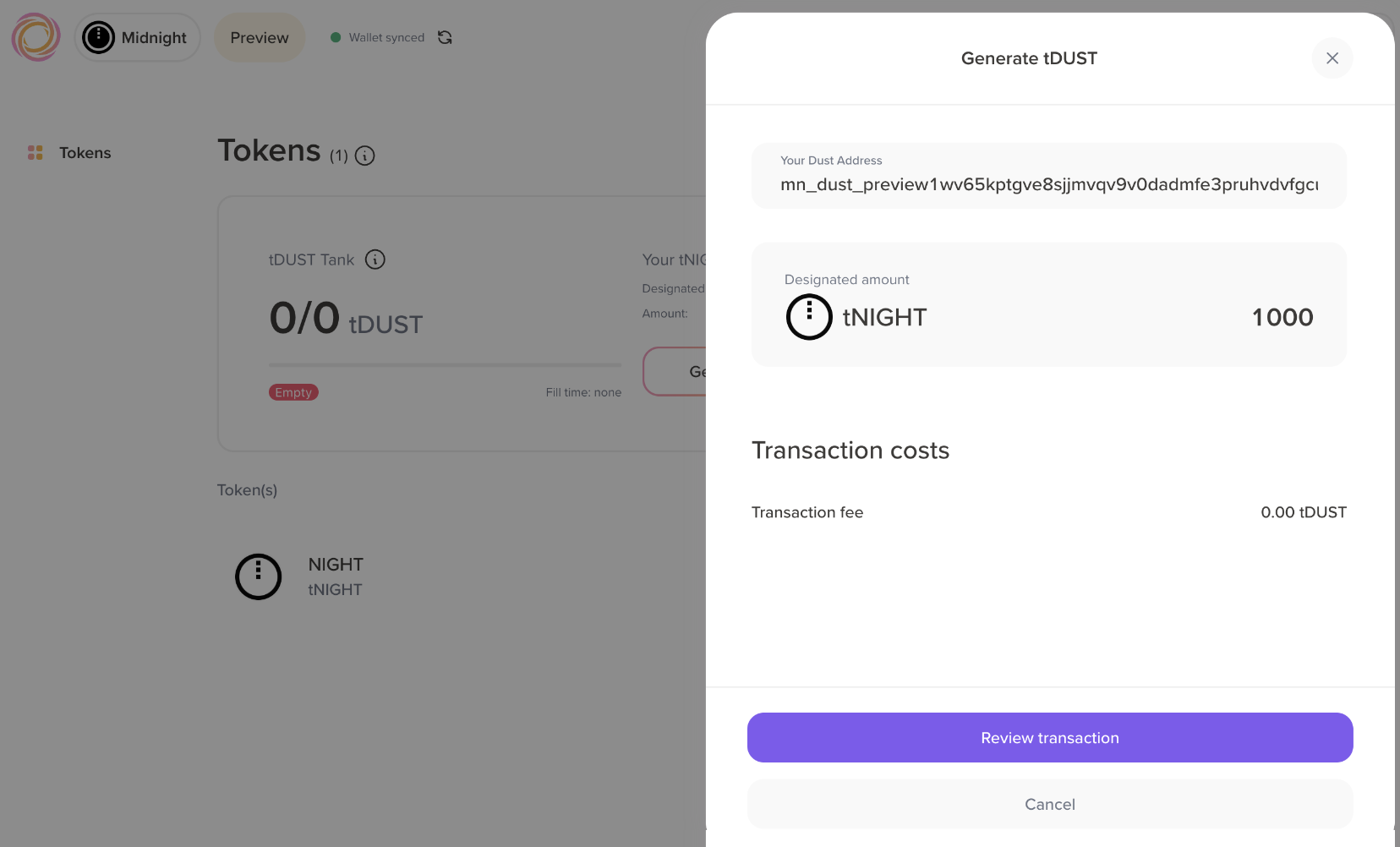
Your tDUST address populates the input field. Select Review transaction, then Confirm to submit the registration.
Verification
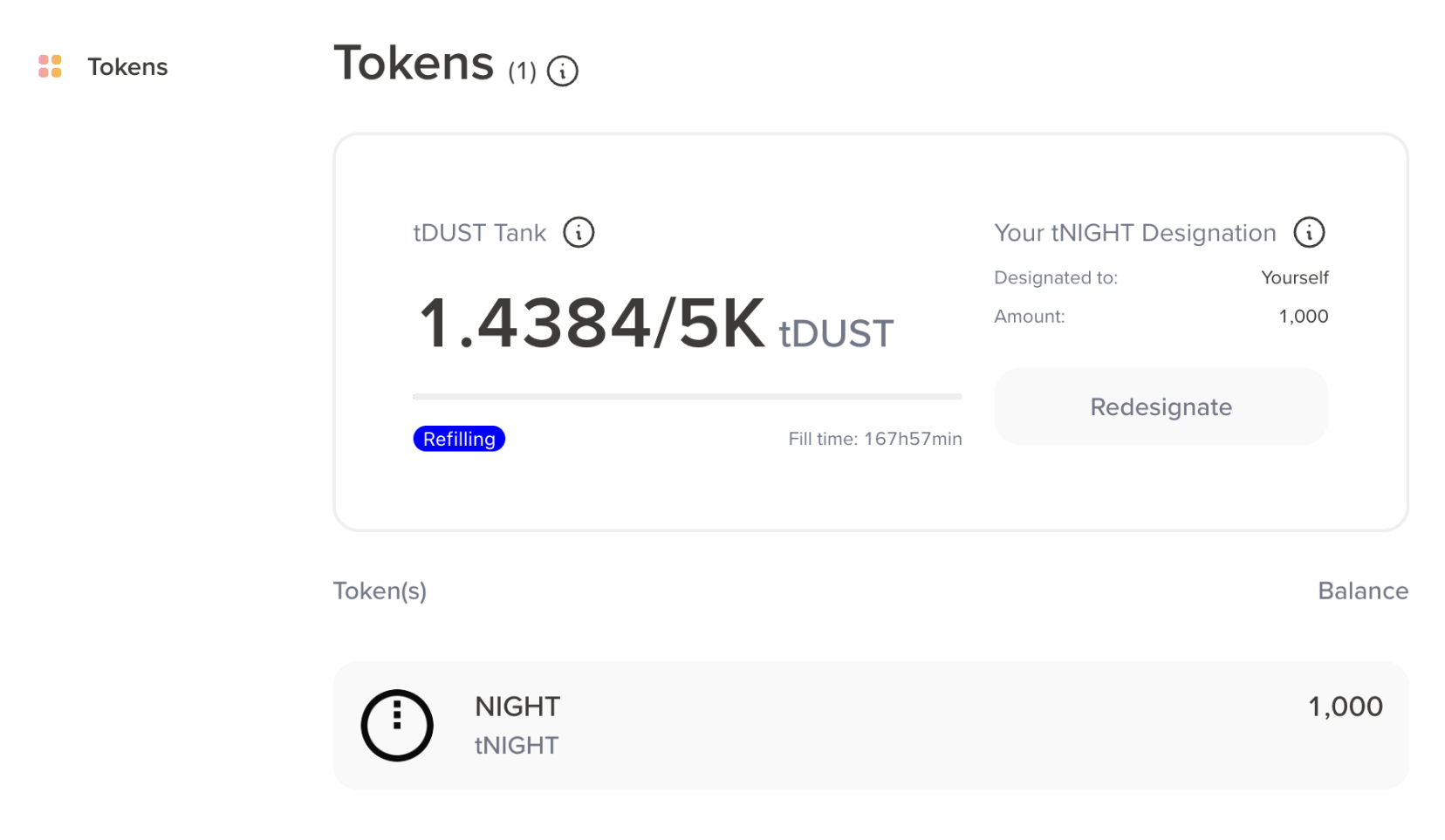
The tDUST tank starts filling and continues to accrue over time, up to a cap set by how much NIGHT you registered.
Setting up the wallet SDK project
Prepare a TypeScript project that can talk to a Midnight network, so the wallet code in the next two procedures has somewhere to run. The three procedures that follow build up a single script, one part at a time.
The wallet SDK ships as the single barrel package @midnightntwrk/wallet-sdk, which re-exports every wallet sub-package. That scope has no hyphen, unlike the @midnight-ntwrk/ packages alongside it.
Procedure
-
Create a project and install the version-matched dependencies. Check the support matrix when versions change:
package.json{"type": "module","scripts": {"start": "tsx src/index.ts"},"dependencies": {"@midnight-ntwrk/midnight-js-network-id": "4.1.1","@midnight-ntwrk/midnight-js-protocol": "4.1.1","@midnight-ntwrk/midnight-js-utils": "4.1.1","@midnightntwrk/wallet-sdk": "1.2.0","rxjs": "^7.8.1","ws": "^8.19.0"},"devDependencies": {"@types/ws": "^8.18.1","tsx": "^4.19.0"}}Then run
npm install. -
Start your local proof server and confirm it answers on port 6300:
curl http://localhost:6300/health -
Create
src/index.tsand add the imports and configuration. The script assigns thewspackage as the global WebSocket before any wallet code runs, which keeps WebSocket behavior consistent across Node versions. The endpoints come from the Environment reference, and the script reads your Blockfrost token fromBLOCKFROST_PROJECT_IDand appends it to each one:import { WebSocket } from 'ws';(globalThis as any).WebSocket = WebSocket;import { Buffer } from 'buffer';import * as Rx from 'rxjs';import {HDWallet,Roles,generateRandomSeed,WalletFacade,ShieldedWallet,DustWallet,UnshieldedWallet,createKeystore,PublicKey,NoOpTransactionHistoryStorage,DustAddress,MidnightBech32m,} from '@midnightntwrk/wallet-sdk';import { toHex } from '@midnight-ntwrk/midnight-js-utils';import * as ledger from '@midnight-ntwrk/midnight-js-protocol/ledger';import { unshieldedToken } from '@midnight-ntwrk/midnight-js-protocol/ledger';import { setNetworkId, getNetworkId } from '@midnight-ntwrk/midnight-js-network-id';setNetworkId('preprod');// The Preprod indexer and node RPC are served by Blockfrost and need a project token.const projectId = process.env.BLOCKFROST_PROJECT_ID?.trim();if (!projectId) throw new Error('BLOCKFROST_PROJECT_ID is not set.');const withBlockfrostKey = (url: string) => `${url}?project_id=${encodeURIComponent(projectId)}`;const CONFIG = {indexerHttpUrl: withBlockfrostKey('https://midnight-preprod.blockfrost.io/api/v0'),indexerWsUrl: withBlockfrostKey('wss://midnight-preprod.blockfrost.io/api/v0/ws'),node: withBlockfrostKey('https://rpc.midnight-preprod.blockfrost.io'),proofServer: 'http://localhost:6300',};
Verification
The proof server answers its health check, which is the one external dependency this project needs beyond the public endpoints:
curl http://localhost:6300/health
{"status":"ok","timestamp":"2026-08-07 11:29:05.352783759 +00:00:00"}
Building a wallet from a seed
Turn a seed into a running wallet. Midnight wallets are three sub-wallets, shielded, unshielded, and DUST, derived from one seed and unified behind a WalletFacade, and the facade is what the registration procedure acts on.
Prerequisites
- The project from Setting up the wallet SDK project.
Procedure
-
Derive the wallet's three key roles from a seed. One seed produces the shielded (
Zswap), unshielded (NightExternal), andDustkey sets by hierarchical deterministic derivation. Read the seed from the environment so re-runs reuse the same wallet, and generate one only on the first run:Save the seedThe seed is the only way to restore the wallet. A script that generates a fresh seed on every run creates a new, empty wallet each time and strands the funds in the previous one.
const seed = process.env.WALLET_SEED ?? toHex(Buffer.from(generateRandomSeed()));if (!process.env.WALLET_SEED) {console.log(`New wallet seed, save this and set WALLET_SEED to reuse it: ${seed}`);}const deriveKeys = (seed: string) => {const hd = HDWallet.fromSeed(Buffer.from(seed, 'hex'));if (hd.type !== 'seedOk') throw new Error('Invalid seed');const result = hd.hdWallet.selectAccount(0).selectRoles([Roles.Zswap, Roles.NightExternal, Roles.Dust]).deriveKeysAt(0);if (result.type !== 'keysDerived') throw new Error('Key derivation failed');hd.hdWallet.clear();return result.keys;};const keys = deriveKeys(seed); -
Build the three sub-wallets and unify them behind the
WalletFacade. The DUST wallet requirescostParameters:feeBlocksMarginsets how many blocks of finalization the fee estimate allows for, andadditionalFeeOverheadis an optional amount that the wallet adds to every fee it declares, which defaults to0nif you omit it. A DUST spend has no refund, so the wallet spends the whole declared fee, overhead included:const shieldedSecretKeys = ledger.ZswapSecretKeys.fromSeed(keys[Roles.Zswap]);const dustSecretKey = ledger.DustSecretKey.fromSeed(keys[Roles.Dust]);const unshieldedKeystore = createKeystore(keys[Roles.NightExternal], getNetworkId());const shieldedConfig = {networkId: getNetworkId(),indexerClientConnection: {indexerHttpUrl: CONFIG.indexerHttpUrl,indexerWsUrl: CONFIG.indexerWsUrl,},provingServerUrl: new URL(CONFIG.proofServer),relayURL: new URL(CONFIG.node.replace(/^http/, 'ws')),};const unshieldedConfig = {networkId: getNetworkId(),indexerClientConnection: {indexerHttpUrl: CONFIG.indexerHttpUrl,indexerWsUrl: CONFIG.indexerWsUrl,},txHistoryStorage: new NoOpTransactionHistoryStorage(),};const dustConfig = {...shieldedConfig,costParameters: {// Optional amount added to every fee the wallet declares. A DUST spend does not return it. Defaults to 0n.additionalFeeOverhead: 300_000_000_000_000n, // 0.3 DUST// Blocks to allow for finalization when estimating the fee.feeBlocksMargin: 5,},};const wallet = await WalletFacade.init({configuration: { ...shieldedConfig, ...unshieldedConfig, ...dustConfig },shielded: (cfg) => ShieldedWallet(cfg).startWithSecretKeys(shieldedSecretKeys),unshielded: (cfg) => UnshieldedWallet(cfg).startWithPublicKey(PublicKey.fromKeyStore(unshieldedKeystore)),dust: (cfg) =>DustWallet(cfg).startWithSecretKey(dustSecretKey, ledger.LedgerParameters.initialParameters().dust),});await wallet.start(shieldedSecretKeys, dustSecretKey);
Verification
Key derivation is deterministic, the addresses carry the network's prefixes, and the facade connects all three sub-wallets to Preprod. The connectivity test distinguishes connected from synced on purpose: a wallet connects in seconds and finishes syncing much later.
import { describe, it, expect, afterAll } from 'vitest';
import { WebSocket } from 'ws';
(globalThis as any).WebSocket = WebSocket;
import { Buffer } from 'buffer';
import * as Rx from 'rxjs';
import {
  HDWallet,
  Roles,
  generateRandomSeed,
  WalletFacade,
  ShieldedWallet,
  DustWallet,
  UnshieldedWallet,
  createKeystore,
  PublicKey,
  NoOpTransactionHistoryStorage,
  DustAddress,
  MidnightBech32m,
} from '@midnightntwrk/wallet-sdk';
import { toHex } from '@midnight-ntwrk/midnight-js-utils';
import * as ledger from '@midnight-ntwrk/midnight-js-protocol/ledger';
import { setNetworkId, getNetworkId } from '@midnight-ntwrk/midnight-js-network-id';

setNetworkId('preprod');

// The Preprod indexer and node RPC are served by Blockfrost and need a project token.
const projectId = process.env.BLOCKFROST_PROJECT_ID?.trim();
if (!projectId) throw new Error('BLOCKFROST_PROJECT_ID is not set.');
const withBlockfrostKey = (url: string) => `${url}?project_id=${encodeURIComponent(projectId)}`;

const CONFIG = {
  indexerHttpUrl: withBlockfrostKey('https://midnight-preprod.blockfrost.io/api/v0'),
  indexerWsUrl: withBlockfrostKey('wss://midnight-preprod.blockfrost.io/api/v0/ws'),
  node: withBlockfrostKey('https://rpc.midnight-preprod.blockfrost.io'),
  proofServer: 'http://localhost:6300',
};

const deriveKeys = (seed: string) => {
  const hd = HDWallet.fromSeed(Buffer.from(seed, 'hex'));
  if (hd.type !== 'seedOk') throw new Error('Invalid seed');
  const result = hd.hdWallet
    .selectAccount(0)
    .selectRoles([Roles.Zswap, Roles.NightExternal, Roles.Dust])
    .deriveKeysAt(0);
  if (result.type !== 'keysDerived') throw new Error('Key derivation failed');
  hd.hdWallet.clear();
  return result.keys;
};

let wallet: any;

afterAll(async () => {
  if (wallet) await wallet.stop();
});

describe('building a funding wallet', () => {
  it('derives the three key roles deterministically from one seed', () => {
    const seed = toHex(Buffer.from(generateRandomSeed()));
    const first = deriveKeys(seed);
    const second = deriveKeys(seed);
    expect(Buffer.from(first[Roles.NightExternal])).toEqual(Buffer.from(second[Roles.NightExternal]));
    expect(Buffer.from(first[Roles.Zswap])).toEqual(Buffer.from(second[Roles.Zswap]));
    expect(Buffer.from(first[Roles.Dust])).toEqual(Buffer.from(second[Roles.Dust]));
  });

  it('encodes a preprod unshielded address with the mn_addr_preprod prefix', () => {
    const keys = deriveKeys(toHex(Buffer.from(generateRandomSeed())));
    const keystore = createKeystore(keys[Roles.NightExternal], getNetworkId());
    expect(String(keystore.getBech32Address())).toMatch(/^mn_addr_preprod1/);
  });

  it('builds the wallet facade and connects all three wallets to preprod', { timeout: 120_000 }, async () => {
    const keys = deriveKeys(toHex(Buffer.from(generateRandomSeed())));
    const shieldedSecretKeys = ledger.ZswapSecretKeys.fromSeed(keys[Roles.Zswap]);
    const dustSecretKey = ledger.DustSecretKey.fromSeed(keys[Roles.Dust]);
    const unshieldedKeystore = createKeystore(keys[Roles.NightExternal], getNetworkId());

    const shieldedConfig = {
      networkId: getNetworkId(),
      indexerClientConnection: {
        indexerHttpUrl: CONFIG.indexerHttpUrl,
        indexerWsUrl: CONFIG.indexerWsUrl,
      },
      provingServerUrl: new URL(CONFIG.proofServer),
      relayURL: new URL(CONFIG.node.replace(/^http/, 'ws')),
    };
    const unshieldedConfig = {
      networkId: getNetworkId(),
      indexerClientConnection: {
        indexerHttpUrl: CONFIG.indexerHttpUrl,
        indexerWsUrl: CONFIG.indexerWsUrl,
      },
      txHistoryStorage: new NoOpTransactionHistoryStorage(),
    };
    const dustConfig = {
      ...shieldedConfig,
      costParameters: { additionalFeeOverhead: 300_000_000_000_000n, feeBlocksMargin: 5 },
    };

    wallet = await WalletFacade.init({
      configuration: { ...shieldedConfig, ...unshieldedConfig, ...dustConfig },
      shielded: (cfg: any) => ShieldedWallet(cfg).startWithSecretKeys(shieldedSecretKeys),
      unshielded: (cfg: any) => UnshieldedWallet(cfg).startWithPublicKey(PublicKey.fromKeyStore(unshieldedKeystore)),
      dust: (cfg: any) => DustWallet(cfg).startWithSecretKey(dustSecretKey, ledger.LedgerParameters.initialParameters().dust),
    });
    await wallet.start(shieldedSecretKeys, dustSecretKey);

    const connected = await Rx.firstValueFrom(
      wallet.state().pipe(
        Rx.filter(
          (s: any) =>
            s.shielded.state.progress.isConnected &&
            s.unshielded.state.progress.isConnected &&
            s.dust.state.progress.isConnected,
        ),
      ),
    );
    expect(connected.isSynced).toBe(false);
    expect(connected.dust.balance(new Date())).toBe(0n);

    const dustAddress = DustAddress.encodePublicKey(getNetworkId(), connected.dust.publicKey);
    expect(String(dustAddress)).toMatch(/^mn_dust_preprod1/);
    expect(MidnightBech32m.parse(String(dustAddress)).decode(DustAddress, getNetworkId())).toBeDefined();
  });
});
 ✓ wallet-construction.test.ts > building a funding wallet > derives the three key roles deterministically from one seed
 ✓ wallet-construction.test.ts > building a funding wallet > encodes a preprod unshielded address with the mn_addr_preprod prefix
 ✓ wallet-construction.test.ts > building a funding wallet > builds the wallet facade and connects all three wallets to preprod

 Test Files  1 passed (1)
      Tests  3 passed (3)
Registering NIGHT for DUST generation with the wallet SDK
Do from code what the Lace procedure does through the UI: fund the wallet, register its NIGHT UTXOs for DUST generation, and watch DUST accrue. This is the part worth scripting, because it is what CI and provisioning jobs need.
Prerequisites
- A running wallet from Building a wallet from a seed.
Procedure
-
Print the unshielded address, fund it from the faucet, and watch for the funds. Balances stream in while the wallet is still syncing, and a balance only ever counts UTXOs from block-confirmed transactions, so a positive balance on a newly funded wallet means the tokens have arrived even though sync is still running.
Balances arrive as
bigintvalues in the smallest denomination. NIGHT divides into 106 STAR, so the faucet's 5,000 tNIGHT reads as5000000000. DUST divides into 1015 SPECK. Convert before displaying:const formatNight = (raw: bigint) =>`${raw / 1_000_000n}.${(raw % 1_000_000n).toString().padStart(6, '0')}`;const formatDust = (raw: bigint) =>`${raw / 1_000_000_000_000_000n}.${(raw % 1_000_000_000_000_000n).toString().padStart(15, '0')}`;console.log(`Send tNIGHT to: ${unshieldedKeystore.getBech32Address()}`);const nightBalance = await Rx.firstValueFrom(wallet.state().pipe(Rx.throttleTime(10_000),Rx.map((state) => state.unshielded.balances[unshieldedToken().raw] ?? 0n),Rx.filter((balance) => balance > 0n),),);console.log(`tNIGHT received: ${formatNight(nightBalance)}`); -
Wait for the wallet to sync, then register the unregistered NIGHT UTXOs for DUST generation. Registration needs a fully synced wallet, so
waitForSyncedStategates this step; keep the process running, because a restarted script syncs again from the beginning. A first registration pays its own fee from the DUST that the NIGHT would have generated since it arrived.estimateRegistrationreturns the amount to reach, andwaitForGeneratedDustwaits until a UTXO has generated it. Without the wait, a registration built too soon after the funds arrive throws before the wallet signs anything. Registration rules covers a UTXO that is too small or too new. The registration is built as a recipe, signed by the unshielded keystore, finalized, and submitted. To direct the generated DUST to a different wallet, decode that wallet's DUST address as the receiver instead:const state = await wallet.waitForSyncedState();const unregistered = state.unshielded.availableCoins.filter((coin) => coin.meta?.registeredForDustGeneration !== true,);if (unregistered.length === 0) {console.log('All NIGHT is already registered for DUST generation.');} else {// Send the DUST elsewhere by replacing this with another wallet's address.const target = String(DustAddress.encodePublicKey(getNetworkId(), state.dust.publicKey));const dustReceiver = MidnightBech32m.parse(target).decode(DustAddress, getNetworkId());// Wait until the NIGHT has generated enough DUST to pay the registration's own fee.const { fee } = await wallet.estimateRegistration(unregistered);await wallet.waitForGeneratedDust(unregistered, fee);const recipe = await wallet.registerNightUtxosForDustGeneration(unregistered,unshieldedKeystore.getPublicKey(),(payload) => unshieldedKeystore.signData(payload),dustReceiver,);const finalized = await wallet.finalizeRecipe(recipe);await wallet.submitTransaction(finalized);}MidnightBech32m.parse(...).decode(DustAddress, ...)is also the validation step: it throws on anything that is not a DUST address for the current network, so a shielded or unshielded address pasted by mistake fails here rather than producing a registration that sends DUST nowhere useful. -
Watch the DUST balance become positive. Generation begins once the registration transaction lands on-chain:
await Rx.firstValueFrom(wallet.state().pipe(Rx.throttleTime(5_000),Rx.filter((s) => s.isSynced),Rx.filter((s) => s.dust.balance(new Date()) > 0n),),);const dustBalance = (await Rx.firstValueFrom(wallet.state())).dust.balance(new Date());console.log(`DUST balance: ${formatDust(dustBalance)}`);await wallet.stop();DUST accrues continuously, so this balance grows between checks until it reaches the cap your registered NIGHT sets.
Verification
A saved seed restores the same wallet, the denominations convert as expected, and a mistyped receiver fails before it can be registered. The assertions below come from a second test file that shares the imports, the deriveKeys helper, and the two formatters shown earlier in this guide:
describe('restored capabilities', () => {
  it('restores the same wallet from a saved seed', () => {
    const seed = toHex(Buffer.from(generateRandomSeed()));
    const addrOf = (s: string) =>
      String(createKeystore(deriveKeys(s)[Roles.NightExternal], getNetworkId()).getBech32Address());
    expect(addrOf(seed)).toBe(addrOf(seed));
    expect(addrOf(seed)).not.toBe(addrOf(toHex(Buffer.from(generateRandomSeed()))));
  });

  it('formats the faucet amount in NIGHT and DUST denominations', () => {
    expect(formatNight(5000000000n)).toBe('5000.000000');
    expect(formatDust(405083000000n)).toBe('0.000405083000000');
  });

  it('rejects a non-DUST address when decoding a DUST receiver', () => {
    const keys = deriveKeys(toHex(Buffer.from(generateRandomSeed())));
    const unshielded = String(createKeystore(keys[Roles.NightExternal], getNetworkId()).getBech32Address());
    expect(unshielded).toMatch(/^mn_addr_preprod1/);
    expect(() => MidnightBech32m.parse(unshielded).decode(DustAddress, getNetworkId())).toThrow();
  });
});
 ✓ funding-helpers.test.ts > restored capabilities > restores the same wallet from a saved seed
 ✓ funding-helpers.test.ts > restored capabilities > formats the faucet amount in NIGHT and DUST denominations
 ✓ funding-helpers.test.ts > restored capabilities > rejects a non-DUST address when decoding a DUST receiver

 Test Files  1 passed (1)
      Tests  3 passed (3)
Running the full procedure against Preprod carries this through to a submitted registration and on to a DUST balance. Re-running it against the same wallet prints the following, with the registration already in place from the first run. The wallet in this run holds 1,000 tNIGHT; a wallet funded by one faucet request shows 5000.000000:
Send tNIGHT to: mn_addr_preprod1857k0p0nmd7g6788h6pr30lkdncg8zt097eq8cl57tx78gwhqlsqnr8r65
tNIGHT received: 1000.000000
All NIGHT is already registered for DUST generation.
DUST balance: 2485.035398999999999
DUST accrues continuously toward the cap that your registered NIGHT sets, so this balance grows between runs. Watch it with the balance check in the final step, or in Lace's tDUST tank.
Funding troubleshooting
The failure modes readers hit most often on the funding path, and their fixes.
| Symptom | Fix |
|---|---|
Faucet says Provided address is invalid | Use the unshielded address (mn_addr_...) with no surrounding whitespace. The faucet rejects shielded and DUST addresses. |
Faucet says rate_limit_error or Reached maximum number of requests | Wait a few hours and retry. If it persists, open a ticket at the Midnight Service Desk or ask in Discord. |
Cannot find module when running the script | Run npm install first. If it persists, delete node_modules and package-lock.json, then reinstall. |
BLOCKFROST_PROJECT_ID is not set., or HTTP 403 errors while the wallet syncs | Set BLOCKFROST_PROJECT_ID to the project ID of a Midnight Preprod project on Blockfrost. A Mainnet project's token gets 403 on Preprod. See Migrating from the Midnight-hosted endpoints for each 403 message. |
| Connection refused on port 6300 | The proof server is not running; see Run the proof server. |
| Balance stays zero after the faucet confirms | Give it a couple of minutes; the wallet detects funds after its next sync. Confirm the address you pasted matches the printed one exactly. |
| DUST stays zero after registration | Give the registration time to land on-chain, then confirm the proof server answers on http://localhost:6300/health. |
Invalid dust address when directing DUST elsewhere | DUST addresses start with mn_dust_ plus the network name; shielded (mn_shield-addr_...) and unshielded (mn_addr_...) addresses are different types. |
Additional resources
- Managing DUST for transaction fees: reading DUST parameters and balances, estimating fees, and sending several transactions once the wallet has DUST.
- Funding and transaction cost: why NIGHT generates DUST and what transactions consume.
- Environment reference: faucets and endpoints per network.
- Run the proof server: the local proof server the SDK path depends on.
- Wallet developer guide: the full wallet SDK surface behind the facade.
- Support matrix: which wallet SDK versions pair with which network components.
- Tokens on Midnight: the NIGHT and DUST model in depth.